Chapter 2 - The Silence Before the Storm
The shattered porcelain lay scattered across the polished marble floor like jagged teeth, the dark pool of coffee creeping slowly toward the toe of Eleanor Voss’s Italian leather shoe.
For three seconds, the grand dining room was entirely suspended in time. The sunlight pouring through the tall plantation windows seemed to grow uncomfortably bright, reflecting harshly off the silver candelabras and crystal water goblets. Not a single donor at the long mahogany table dared to move. The women clutched their linen napkins a little tighter; the men stared fixedly at their plates as if the roasted salmon had suddenly become the most fascinating object in South Carolina.
Eleanor Voss’s face twitched, the mask of benevolent philanthropy slipping just enough to reveal the cold, calculating tyrant beneath. Her nostrils flared. She had spent thirty years cultivating an image of immaculate grace, building a multi-million-dollar foundation on the backs of vulnerable women while quietly crushing anyone who threatened her absolute authority.
“Abigail,” Eleanor hissed, her voice trembling with suppressed rage, every syllable dripping with venom. “You ungrateful, clumsy little wretch. Look what you’ve done to the floor.”
Abigail Mercer didn't look down at the mess. Her cheek burned from the force of the slap, the skin stinging and flushing hot against the cool air-conditioned draft of the room. Her shoulders were rigid. For six years, she had absorbed the blows, the insults, the endless laundry cycles, and the soul-crushing humiliation of living as a prisoner in the very home where her late husband had grown up. She had done it for Tess, for Sadie, and for little Nora. She had believed that if she stayed quiet, if she bowed low enough, Eleanor’s wrath would eventually spare her daughters.
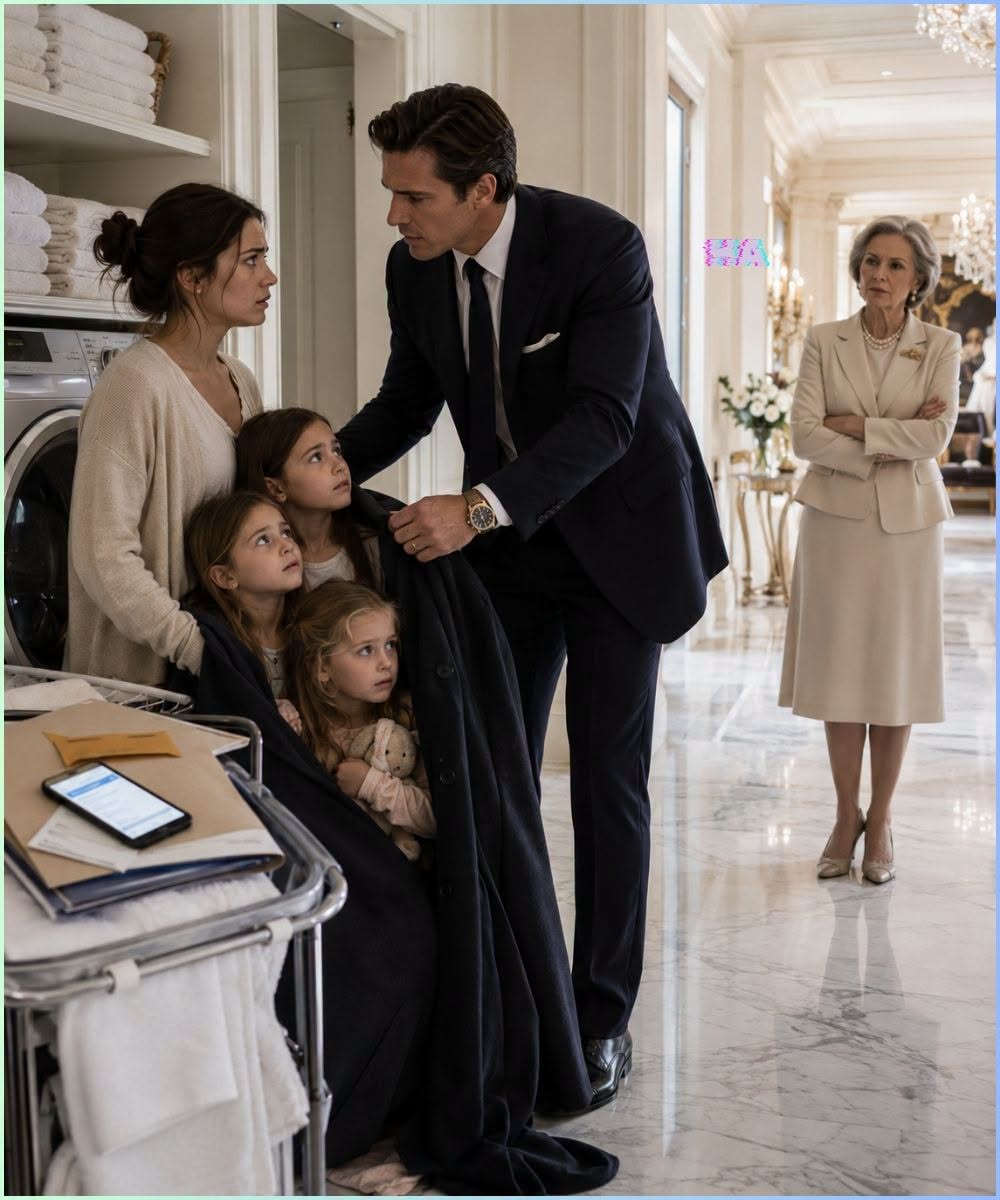
Instead, they had been banished to the narrow, suffocating hallway beside the industrial washing machines. They had been treated like stray dogs in a house built on charity.
Tess, standing protectively in front of her younger sisters, stepped forward and grabbed the hem of Abigail’s gray maid’s dress. “Mommy, let’s go. Please. Let’s go back to our room.”
Nora was sobbing now, her small frame shaking as she buried her face in Sadie’s skirt.
Before Eleanor could raise her hand again—before she could issue another cruel decree or summon her security guards to drag them away—a sharp, deliberate sound broke the stillness.
Clack.
It was the sound of Adrian Hale setting his heavy silver fork down beside his untouched plate.
Every head at the table turned toward him.
Adrian remained seated at the far end of the long table, towering over the other donors even while resting against the high-backed chair. His tailored charcoal suit fit with immaculate precision, but it was his eyes that commanded the room—a pair of cold, piercing gray irises that looked as though they could calculate the net worth and moral bankruptcy of every person present in a single glance.
He had not touched his food. He had watched the entire exchange from the moment the children appeared in the doorway, his gaze tracking every movement, every flinch, every drop of blood-pushed humiliation.
“Is that how you protect vulnerable women, Eleanor?” Adrian asked.
His voice was not loud. It didn't boom across the vaulted ceiling. It was quiet, steady, and carried the terrifying gravity of a man who owned entire shipping fleets and dictated the economic pulse of the eastern seaboard.
Eleanor’s expression shifted instantly from furious rage to defensive panic. She forced a strained, brittle laugh, her fingers tightening around the silver handle of her coffee pot.
“Adrian, please,” she said, her voice dripping with false intimacy. “You know how these domestic staff members are. They lack discipline. They bring their personal burdens into a professional environment. I was merely teaching her a lesson about boundaries—”
“You struck a mother in front of her children,” Adrian interrupted, his tone chillingly flat. “In a home that flies a banner proclaiming that no woman should face hardship alone.”
A flush of absolute humiliation crept up Eleanor’s neck, turning her powdered skin a mottled red. Several donors lowered their eyes, suddenly finding the embroidered logos on the table runners deeply interesting. The hypocrisy was glaring, illuminated by the harsh spotlight of a billionaire who refused to play along with Charleston high-society theater.
Adrian pushed his chair back. The legs scraped against the hardwood floor with a sharp groan.
He stood up, towering over six feet two inches, and buttoned his jacket with deliberate slowness. He didn't look at Eleanor again. Instead, his gaze locked entirely onto Abigail and her three trembling daughters.
“You’re done here, Mrs. Mercer,” Adrian said, his voice softening just enough to carry across the room without losing its iron authority.
Abigail stared at him, stunned, her breath catching in her throat. “Mr. Hale... I... I have nowhere else to go.”
May you like



“You do now,” he replied.
Adrian reached down and unfastened the heavy, dark wool overcoat draped over the back of his chair. Without waiting for permission, without caring about the gasps of shock from the surrounding donors, he walked past the shattered porcelain and the pool of coffee, crossed the marble floor, and draped his warm, heavy coat over the shivering shoulders of little Nora, before extending his arm to shield Abigail and her girls from the toxic gaze of the room.