Chapter 2 - The Forbidden Door
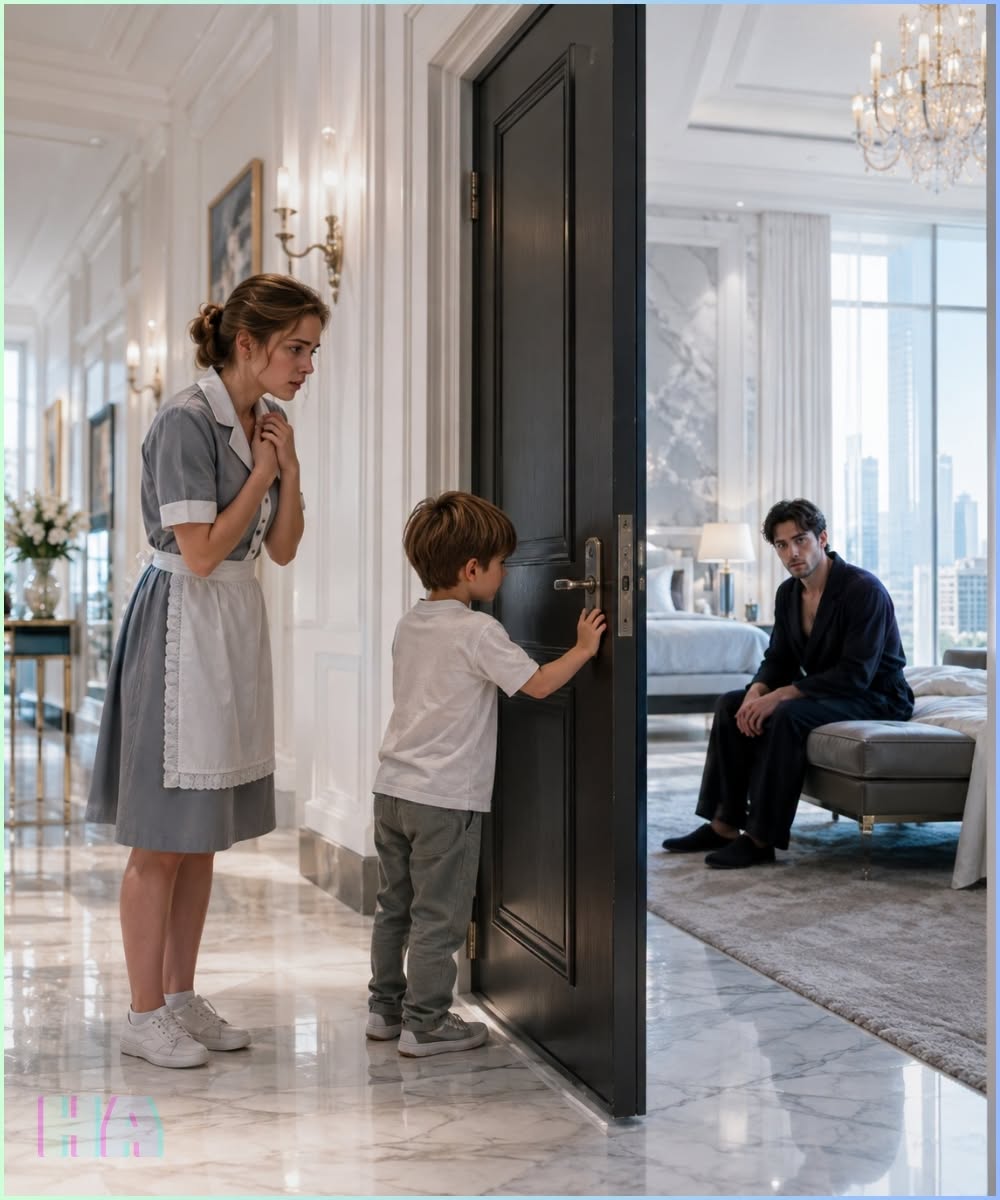
The silence in the master bedroom was thick enough to choke on.
Claire did not drop her eyes. Her knuckles turned white around the plastic handle of the medication tray, but her chin remained up. She had faced down furious land lords, condescending bank officers, and a deadbeat husband who had stolen her life savings while she slept. She was not going to break down in front of an old man in a wheelchair, no matter how many billions of dollars sat in his bank accounts.
"I asked you a question, Ms. Bennett," Everett Hale said, his voice grating like iron dragged across stone. "Did you think this house had no windows? Or did you assume an old dying fool wouldn't notice a four-year-old boy hiding in the staff quarters?"
"I assumed you were a man who valued efficiency," Claire replied, her voice remarkably steady. "My son is quiet. He does not run in the halls. He does not break things. And my work will be flawless. If my performance falls short for even one day, you can fire me without severance."
Everett leaned forward slightly. The dim light from the hallway caught the hollows of his cheeks and the sharp, hawkish line of his nose.
"You're insolent."
"I'm desperate, Mr. Hale," Claire corrected him smoothly. "There is a difference. Insolent people waste your time. Desperate people work harder than anyone else in this house."
Everett stared at her for five long seconds. Then, a dry, wheezing cough rattled through his chest. He pulled a white linen handkerchief from his pocket, pressed it to his mouth, and waved a dismissing hand toward the door.
"Take the tray," he muttered. "The tea is lukewarm. Tell Delaney if she serves me swill again, I'll replace her with a vending machine."
Claire picked up the tray, turned on her heel, and walked out without another word.
Downstairs in the massive stainless-steel kitchen, Mrs. Delaney was standing by the center island, her hands folded tightly over her apron. When she saw Claire walk through the swinging doors, she let out a long breath she seemed to have been holding for ten minutes.
"You're still employed," Mrs. Delaney observed.
"For now," Claire said, setting the tray on the counter. "He complained about the tea."
"He always complains about the tea. It gives him a reason to wake up in the morning." Mrs. Delaney glanced toward the laundry room door, where a faint murmur of a child singing could be heard. "Where is the boy?"
"In our room. Coloring."
"Keep him there, Claire. I mean it. Today isn't a normal day. Mr. Hale's nephew is coming from New York. Julian Hale." Mrs. Delaney’s face hardened, her posture stiffening. "Julian doesn't come here to check on his uncle's health. He comes to check on his inheritance. If he sees a child on the property, he will use it as an excuse to cause trouble."
Before Claire could ask what kind of trouble, the heavy iron chime of the front entrance echoed through the mansion.
An hour later, the quiet peace of Hale House was shattered.
Julian Hale did not walk into a room; he invaded it. He was thirty-eight years old, wore a three-thousand-dollar suit that couldn't hide the soft rot of a lazy life, and carried himself with the loud, obnoxious confidence of a man who had never earned a dollar he spent. Accompanying him was Richard Vance, a sharp-featured estate attorney carrying a leather briefcase the size of a microwave.
Claire was dusting the mahogany banister near the grand foyer when Julian’s voice boomed up toward the painted ceiling.
"Where is he, Delaney?" Julian demanded, tossing his cashmere coat onto a velvet bench. "Don't tell me he's resting. I drove two hours in the rain. Vance brought the updated health proxy documents."
"Mr. Hale is in his quarters, Mr. Julian," Mrs. Delaney said coldly, standing at the foot of the stairs like a stone guard. "He specifically requested not to be disturbed until two o'clock."
"I don't give a damn what he requested!" Julian snapped, stepping into Mrs. Delaney's personal space. "He's eighty-two years old and his heart is giving out. Every decision he makes right now needs oversight. Where is the new housekeeper? I want coffee. Real coffee, not the sludge you people brew."
Julian’s eyes flicked up the staircase and locked onto Claire.
His gaze crawled over her faded jeans, her oversized staff polo shirt, and the duster in her hand. A small, cruel smirk touched his lips.
"You," Julian called out, snapping his fingers. "Bring a tray of dark roast to the library. And make it quick. I don't have all day to sit in this mausoleum."
"Yes, Mr. Hale," Claire said softly, swallowing her pride for the sake of the thirty-one dollars in her bank account.
She turned to head toward the service stairs, her heart hammering against her ribs. She needed to get back to the ground-floor room to check on Owen. He had been playing quietly with his paper cups and crayons, but he was four—his curiosity was a force of nature.
What Claire didn't know was that ten minutes earlier, a breeze from an open laundry window had blown Owen’s favorite drawing out into the hallway.
Owen didn't mean to break the rules.
He knew the rules. Mommy had explained them three times while they were eating peanut butter sandwiches on the edge of their small bed.
Rule Number One: Stay in the room. Rule Number Two: Be as quiet as a mouse. Rule Number Three: Don't touch the big doors.
But the yellow crayon drawing—a picture of a sun with twenty-two rays and a house with a giant chimney—had skittered across the polished floorboards like a falling leaf. Owen had tiptoed out to catch it. Then he saw the stairs.
They were wide, carpeted in deep crimson velvet, and curved up into the high darkness of the second floor like a mountain path.
Owen loved mountains.
Holding his crumpled yellow paper, his mismatched red and blue socks silent against the carpet, the four-year-old padded up the stairs.
The second-floor hallway was long, dark, and smelled of old books and lemon oil. High portrait paintings of stern men with long beards watched him from gilded frames. Owen ignored them. He was looking for the sun.
At the very end of the hall stood an enormous double door made of dark walnut, carved with figures of lions.
Every other door in the hallway was shut tight. But this one was cracked open just half an inch. A tiny, golden sliver of light spilled out onto the floor.
Owen walked up to it. He put his small palm against the heavy wood.
He pushed.
The heavy door swung open without a sound.
The master bedroom was swallowed in shadow. Heavy velvet drapes blocked out the sky, leaving only a faint red glow from a dying fire in the hearth.
In the center of the room sat a massive wheelchair.
Everett Hale was staring at the wall, a wool blanket pulled over his knees. His thin, frail hands rested on the wheels. He looked like a statue left behind in an abandoned museum.
Owen stepped inside. His rubber-soled sneaker made a tiny squeak against the hardwood floor.
Everett didn't turn his head. "I told you, Delaney, I don't want the broth."
"I'm not Delaney," a small voice piped up.
Everett froze.
Slowly, painfully, the old billionaire turned his wheelchair around. His pale, sunken eyes widened as he looked down at the tiny human standing three feet away from him.
Owen was wearing a faded blue shirt with a cartoon dinosaur on it. His brown hair was sticking up on one side, and in his left hand, he held a broken yellow crayon.
"What..." Everett’s voice rasped, caught between disbelief and outrage. "What are you?"
"I'm Owen," the boy said matter-of-factly. "I'm four."
"Who let you in here?" Everett barked, his knuckles turning white on his armrests. "Where is your mother? Where is security?"
Owen didn't flinch. When you were four, grown-ups yelled all the time—about spilled juice, about loud TV, about shoes on the couch. Yelling was just noise.
He walked straight past the terrifying billionaire, stopped at the massive velvet curtain hanging over the east window, and grabbed the heavy golden tassel.
"You're not supposed to touch that!" Everett shouted, reaching for the bell on his side table.
Owen pulled.
The heavy drape slid back six inches. A sharp, brilliant beam of afternoon sunlight cut through the dusty gloom, landing directly across Everett’s lap and illuminating the old man's pale, lined face.
Everett blinked, shielding his eyes with a frail hand. "Close that!"
Owen turned around, crossing his arms over his dinosaur shirt.
"You look less dead with the light on," Owen declared.
Everett Hale, a man who had made international trade ministers weep, sat paralyzed in his wheelchair, staring at a child who had just evaluated his mortality with a broken crayon in his hand.
"What did you say to me?" Everett whispered.
"My grandma looked like you before she went to heaven," Owen explained simply, walking over and leaning his elbows on the arm of Everett’s wheelchair. He smelled like baby shampoo and peanut butter. "She stayed in the dark all day. It made her face yellow. Sunlight makes you pink."
Owen reached out and placed his broken yellow crayon directly into Everett Hale’s cold, withered palm.
"You can have this," Owen said. "To draw a sun."
May you like


Everett looked down at his hand. The crayon was small, warm, and waxy.
For the first time in eight years, the old billionaire didn't have a single word to say.